We added the reviewer's advice on passed drafts to the next writing session. Then we had to fix the code that decided whether a draft had been rejected.
Our Content Review agent can pass a piece and still leave a note about a weak sentence. Before this change, the feedback helper returned rejection reasons and reviews of related material, but left out the notes on recent passed pieces. A writer could satisfy the review without seeing advice that would matter on its next run.
The November 18 integration gives the X post, X video and LinkedIn video writers notes from up to five recent pieces by the same agent whose reviews passed or accepted an edit. It reads the newest pieces first, counts each piece once even if it has several review rows, and excludes entries marked deleted in the supported publishing registries before choosing which pieces to read. A matching local review supplies its first reason. Otherwise, the shorter note in the review log stands in.
I want this small set of advice in the writing prompt because the next session otherwise has no reason to know what the reviewer disliked last time, and copying the whole history would make the writer sift through older material to find it.
That introduced a problem in the caller. The X post runner used a nonempty feedback block as evidence that this particular draft had been sent back before. Once advice on passed pieces joined that block, an ordinary new draft could receive rejection instructions meant for a revision.
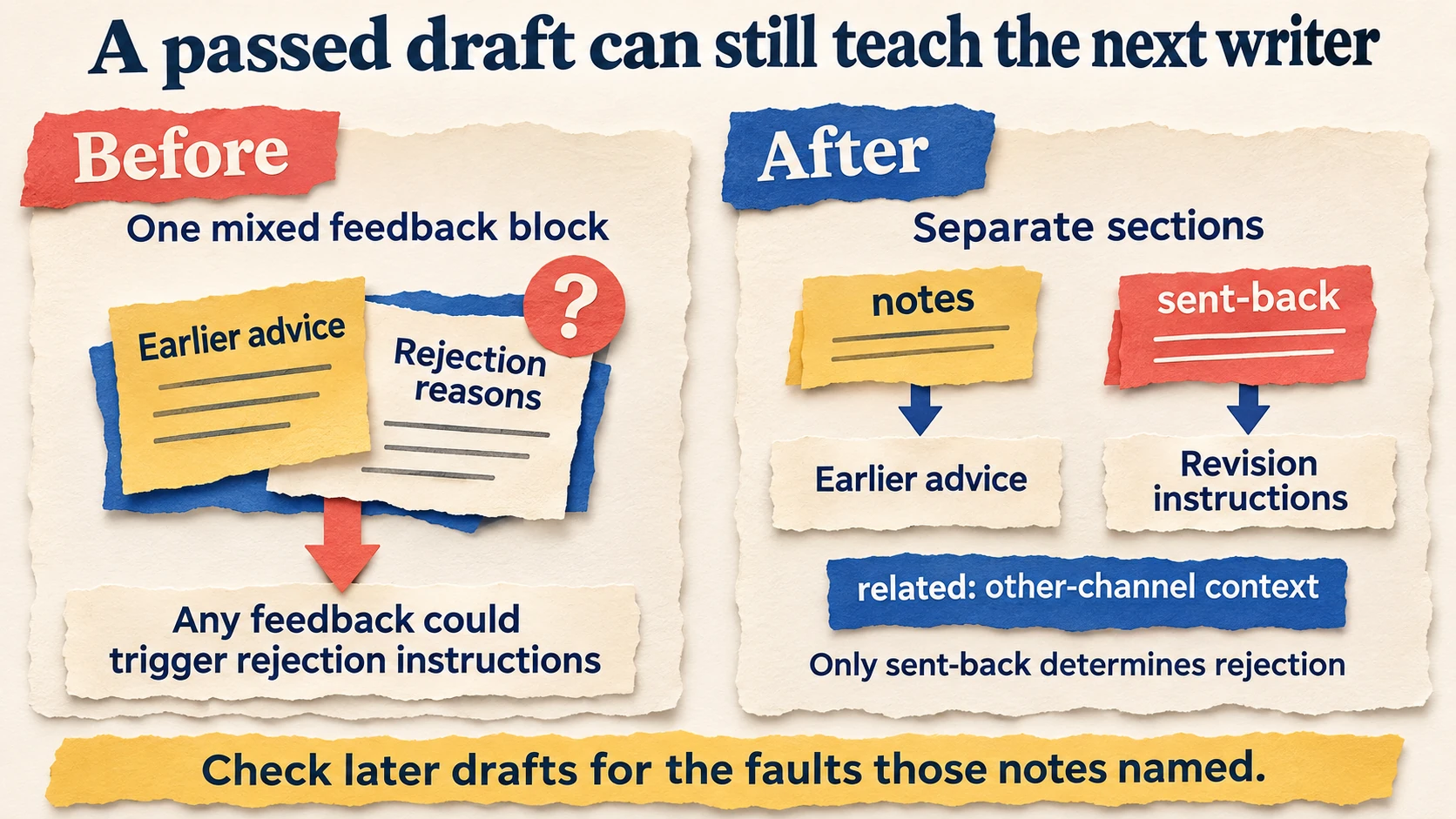
We separated the helper's output into three sections: sent-back, related and notes. The runners request each section separately. Only sent-back determines whether they tell the writer that this piece was rejected; the video writers can still carry comments about the same material on another channel. Advice from earlier passed pieces goes into its own section of the prompt.
There is some filtering before that advice reaches the writer. The helper removes common approval-only phrases and repeated notes, and limits how much of each note it carries. That is text matching. It cannot decide whether a reviewer's suggestion was good, or whether it fits the next subject.
The checks confirm that historical advice can be present while the current draft's rejection section stays empty. They do not tell us whether the next post reads better. I would keep this change, then inspect subsequent drafts for the faults those notes named. If the same fault keeps returning, we will need to look at what the writer did with the advice.